
At Dawn on the Dock: A Quiet Shift, a Bigger Question
Sun’s barely up, and the dock lights hum like cicadas after rain. A pallet stacker waits by the second bay, forks low, battery topped, crew shuffling in with coffee. Last quarter, the line moved 18% more loads, but mis-picks nudged up 3%, and idle time still ate a good chunk of the shift—funny how that works, right? If the floor looks steady, why do the metrics look wobbly? Is it the gear, or the way we run it, or both?
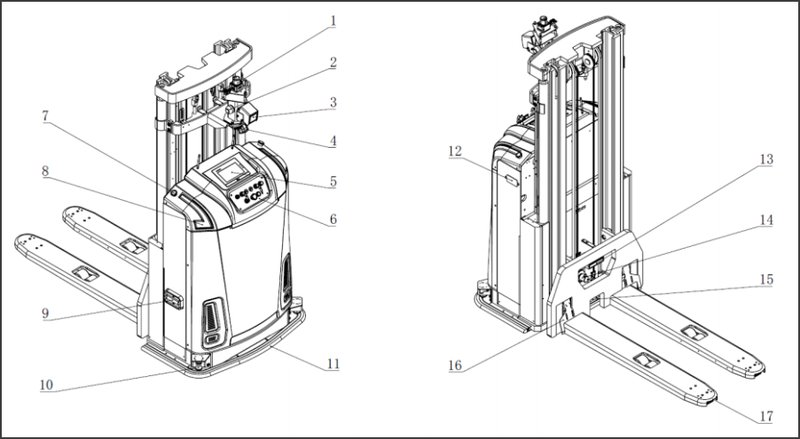
I reckon a lot of folks see a lift, punch the clock, and go. But the small drifts matter: uneven aisles, variable pallets, tight turns, tired eyes. They stack up like cordwood. So here’s the rub—when speed rises, tiny errors scale too. That’s the quiet math behind most dock days (no fuss, just the truth). Can the tools catch up with the way we actually work, not the way the manual says we should? Let’s roll into that and see what shakes out next.
The Hidden Costs of Old-School Lifts
A modern stacker forklift promises smoother throughput, but first, let’s name why the old fixes keep slipping. Classic setups rely on fixed presets and operator feel. They assume a steady load center, clean floors, and predictable cycles. Real floors aren’t like that. Drifts come from signal noise on the CAN bus, sag in power converters under peak draw, and changes in duty cycle when shifts get hot. Add mast deflection from mixed pallets, and your “repeatable” move now wanders by a few centimeters. Look, it’s simpler than you think: small variances stack into rework.

Why do legacy fixes stall?
They chase symptoms. A speed cap trims risk but also kills cycle time. A wider safety buffer reduces near-misses but blocks tight staging. A heavier fork plate helps with odd pallets, yet bumps battery swaps. Each patch solves one slice and taxes another—trade-offs on trade-offs. Without adaptive sensing, the system can’t tell wet floor from worn wheel. Without load-aware control, torque responses stay blunt. And if operator prompts live in a clunky HMI with no context, folks tap past them. The outcome: creeping delays, extra aisle passes, and elastic ETAs that make planning flaky. It’s not bad work. It’s bad fit.
New Principles, Clear Gains
Let’s flip the lens to how the newer rigs think—comparative, not reactive. The latest control stacks pair edge computing nodes with multi-sensor fusion. LiDAR and vision cross-check pallet skew, while inertial data smooths jitter. Instead of fixed curves, the motion planner tunes on the fly by weight, lift height, and aisle width. When a stacker forklift sees a narrow gap, it adjusts acceleration and braking, then trims fork tilt to keep the center of mass calm. If the floor shines wet, wheel slip is caught early. Fewer hard stops. Fewer nudges. More clean cycles—small steps, big effect.
What’s Next
Two shifts ahead, the stacker will forecast. Battery management systems will share limits with the planner, so the route lines up with charge windows. OTA updates will drop new slotting rules by zone, not the whole site. And digital twins will test a new layout overnight—then serve settings in the morning (no drama, just data). You still drive goals, not gadgets. But the machine covers the messy middle—funny how that finally clicks, right? Summing up the road so far: the old gear asked operators to smooth the chaos; the new gear eats the chaos for breakfast.
Before you pick your path, use three simple yardsticks: 1) cycle-time consistency under mixed loads, not just best-case runs; 2) energy per pallet moved, in Wh per pallet, across a full duty cycle; 3) recovery speed from sensor occlusion, measured in milliseconds to stable control. If a system scores strong on those, the rest tends to follow. And if you’re weighing options or just mapping next steps, keep the conversation grounded and clear with SEER Robotics.